
From pilot to practice: how Rose the digital assistant is supporting adult social care information and advice
As local authorities and the public sector explore ways of using AI tools to deliver trusted information more quickly to residents, we hear from cc2i’s Jane Hancer and Bullet’s Simon Wilson about Rose, their AI digital assistant project with West Northamptonshire Council.
Q: Many councils are exploring new ways to improve access to information and advice for residents. Can you briefly introduce your organisations and the challenges you’re helping to address?
Jane: “I work for CC2i, and we’re the country’s only crowdfunding platform for local authorities and the public sector. We’ve brought the concept of crowdfunding into local government, allowing local authorities and their partners to share the cost of innovation and develop solutions with leading technical experts."
Simon: “We’re Bullet, a technical agency that’s been delivering digital and web work for well over 12 years. A lot of that is public sector: local government, NHS projects, public health. In the last couple of years we’ve been exploring AI to help end users navigate complex information and improve how services are delivered.”
Q: How did you first start working together?
Simon: “We’d spoken years ago about another product, a traded services platform where councils could offer and buy things like school services.
We found CC2i through a search, had a really good conversation, and it didn’t go anywhere at the time, but we remembered it. When we moved into the AI space, it felt like a logical conversation to revisit.”
Q: What was the starting point for the AI work in councils?
Jane: “Bullet had been working with Medway Council on a WhatsApp version of a breastfeeding service. We were really interested because we could see the application across other areas of local government, especially where information is complex and spread across multiple sites.
We said: let’s get that pilot live, so we’ve got something real to show. Then we built a simple demo on adult social care information, and that’s what helped get councils interested as co-funders.”
Simon: “Once people could actually see it working, and see how it helps residents, it became a much easier conversation.”
Q: Which councils helped get the adult social care assistant off the ground?
Jane: “Norfolk and Bradford were the first main co-funders for the adult social care AI assistant. Norfolk had been part of one of our earlier collaborations. After a webinar showing the concept, they were in straight away. Bradford took a bit more time — they were particularly driven by multilingual access and the need to support demand coming in through the ‘front door’.”
Q: Why is AI a good fit for public service information and advice?
Jane: “In this case, it gives residents the opportunity to have a conversation with trusted content rather than searching through multiple websites and structures. It’s faster, it’s clearer and it can be available at any time.”
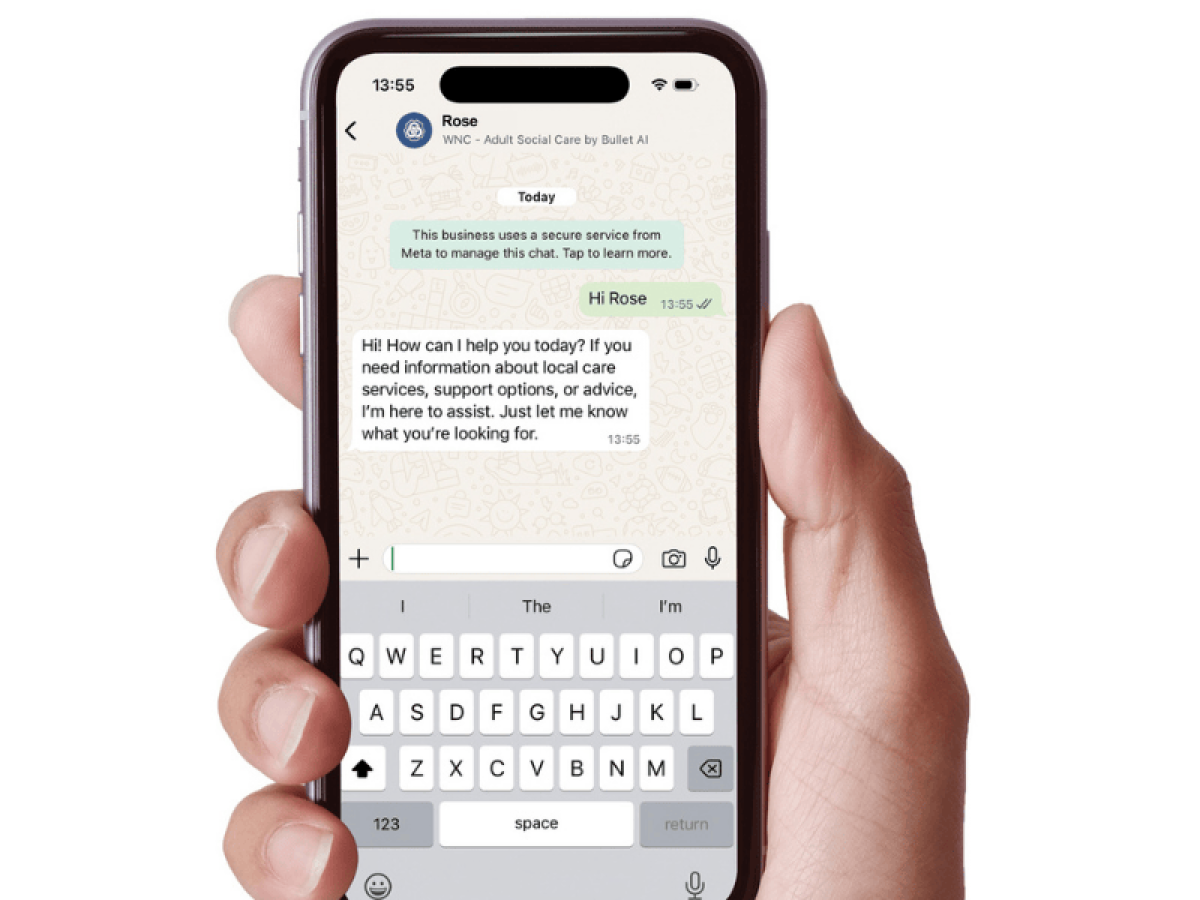
Simon: “It’s also about meeting people where they already are. Using WhatsApp, where people are used to having conversations already, has been a real positive. If you can give accurate, consistent answers in the channels people use every day, you remove friction.”
Q: So who is ‘Rose’ and what does she do?
Jane: “Rose is the newest member of West Northamptonshire’s adult social care information and advice team. She’s available 24/7. She’s trained on trusted and curated information and advice from West Northamptonshire Council, local providers and national care and health sources. It’s the first time we’ve brought all that together to provide a comprehensive ‘version of the truth’ in one place.”
“She’s available on WhatsApp, so you can have a conversation any time of day — by voice or text — and in different languages. Rose can manage multiple conversations at once, so it’s an expandable resource that helps people get information quickly.”
“And you can return to the conversation. If you asked something weeks ago and can’t remember the answer or link, you can scroll back, find it and ask follow-up questions.”
Q: What’s the main benefit for residents?
Simon: “Speed and accessibility. People can ask a question and get an answer immediately, without needing to understand how the council website is structured or where information sits.”
Jane: “It’s also about confidence — it’s trained on trusted information. People know they’re getting advice that’s based on the right sources.”
Q: How does this help council teams and contact centres?
Jane: “It builds capacity. Rose can handle multiple conversations at one time, so it supports demand and helps improve response times. That means staff can focus their time where human support is most needed.”
Simon: “It takes away some of the repetitive ‘where do I find...?’ questions, which can absorb a lot of time. That’s where AI can genuinely act like an assistant.”
Q: You’ve worked with different types of teams — public-facing services and IT. What have you learned?
Simon: “When IT and innovation teams are close to the project, decisions move faster. Where teams are more detached, it can become more document-heavy because people are responding to ‘AI’ as a concept rather than understanding the product.”
“The best outcomes come when the people who understand the service need are working closely with the people delivering the technology.”
Jane: “Having an innovation programme makes a huge difference. Some local authorities have frameworks that support piloting and learning — they understand things will evolve. That creates momentum and helps staff feel like innovation is something happening with them, not to them.”
Q: How have you found West Northamptonshire Council’s approach to innovation?
Jane: “There’s an innovation programme and a framework for testing and incubating projects. That’s not common, and it’s inspiring. It creates a culture where teams are excited because they can see the work is trying to solve real problems.”
Simon: “It’s that ‘let’s test it, learn from it, improve it’ mindset. West Northants joined later but moved quickly, and that pace is often the difference between something staying theoretical and something actually helping residents.”
Q: How do you make sure AI use is safe and appropriate in public services?
Jane: “One key point is that this has been done in a safe domain. Rose provides information and advice without involving personal information. It’s a sensible way for councils to build experience and governance while delivering value.”
“We’ve also focused on safeguarding. The tool includes monitoring that can flag messages that may indicate safeguarding concerns, so councils can review and follow up."
Simon: “Guardrails are critical. This isn’t a ‘wild’ chatbot. It’s built around trusted content and controlled behaviour.”
Q: What safeguarding features are in place?
Jane: “The system can flag messages that suggest potential safeguarding issues such as risks related to violence or self-harm. Those flagged messages can be reviewed through a dashboard, and councils have a process for monitoring and escalation. We are also able to proactively request and/or suggest people get in touch with the council or other relevant services to discuss the situation and, critically, share their contact details.”
Simon: “We can see in the back office that flagged messages are being viewed and monitored, and part of the work is helping teams formalise the process so it’s clear who checks what and when.”
Q: Is this the finished product, or the start of something bigger?
Simon: “It’s the start. Right now, Rose is providing reactive support, answering questions when people ask. But there’s real potential to support people through journeys: helping with next steps, guiding through pathways and supporting longer processes like assessments.”
“We’re also exploring voice. The technology is moving quickly, the idea of people being able to call and have a real-time conversation with a guardrailed, trusted assistant is getting closer.”
Jane: “AI is going to be bigger than the advent of the web. Starting early helps councils understand the implications, build capability, and identify where it can help services most.”
Q: What would you say to councils considering AI but unsure where to start?
Jane: “Start with a clear ‘why’, the problem you’re solving, and begin in an area where the value is immediate and the risk is easier to manage.”
Simon: “Don’t wait for perfection. Pilot it, learn and improve. The point is to get something into residents’ hands and see what works. That’s how you build confidence and capability.”
Q: Finally, what does success look like?
Jane: “Residents getting the right information at the right time, in the way that suits them, and councils building capacity and confidence in using AI responsibly.”
Simon: “Faster answers for the public, less pressure on front doors and a platform you can build on. This is only going to become more important over the next year and beyond.”